Grosse Pointe could have been the Newport, Rhode Island of the Midwest.
That sounds grandiose until you remember what Grosse Pointe had.
It had the water. It had the mansions. It had the lakefront lawns, the great houses, the carriage houses, the boathouses, the servants’ quarters, the gardens, the clubs, the churches, the schools, the old trees, and the mythology. It had Detroit’s industrial fortunes flowing eastward to Lake St. Clair and transforming farmland and summer cottages into one of the most privileged residential strips in America.
It had the Fords, the Dodges, the Algers, the Chapins, and all the other names that made Detroit more than a city. Detroit was not merely a place where cars were assembled. It was an engine of modern American wealth, and Grosse Pointe became one of the places where that wealth went home at night.
It had everything a place needs to become legendary.
And yet, unlike Newport, Grosse Pointe never fully turned its grandeur into a public inheritance. Newport took its Gilded Age mansions and, through preservation, philanthropy, tourism, and civic imagination, made them accessible. The great houses became museums, landmarks, wedding backdrops, architectural classrooms, cultural engines, and reasons for visitors from around the world to come and look.
Grosse Pointe largely kept its back turned.
The hedges stayed high. The gates stayed closed. The lakefront remained private. The houses were seen in glimpses from Lake Shore Drive, from a boat, from rumor, or from childhood imagination. They were not so much shared as concealed.
In Newport, excess became history.
In Grosse Pointe, too much of it became real estate.
That is the sadness of it. Grosse Pointe did not lack beauty. It lacked an idea large enough to rescue its beauty from privacy, inheritance, taxes, decay, and the bulldozer.
There were, of course, partial exceptions. The Alger estate, The Moorings, became the Grosse Pointe War Memorial. The Edsel and Eleanor Ford House survived and became a public historic estate. The Grosse Pointe Historical Society has worked for generations to preserve and tell the story of the five Grosse Pointes. These were not small things. They mattered. They still matter.
But they were fragments.
What never seemed to appear was the larger civic imagination: a vision of Lake Shore Drive as a cultural corridor, a Midwestern Bellevue Avenue, a place where Detroit’s industrial aristocracy could be understood in architecture, landscape, art, class, ambition and memory.
It would have required money, yes. But Grosse Pointe had money.
It would have required leadership. That was the harder commodity.
It would have required old families to see their houses not merely as private possessions, but as part of a public story. It would have required foundations to imagine that saving lakefront mansions was not just an indulgence for the rich, but a way to preserve the story of Detroit itself. It would have required the municipalities of the Grosse Pointes to think beyond their borders, beyond their zoning maps, beyond their usual suspiciousness of outsiders.
The Ford Foundation could have done it.
That is one of the great “what ifs.” The foundation began in Michigan, born from Ford money, and had the financial capacity to do something almost unimaginable. It could have purchased major lakefront estates at fair market value. It could have established a trust. It could have created a series of public house museums, gardens, archives, lecture halls, restaurants, walking paths, and cultural programs. It could have made Grosse Pointe a required stop for visitors to the Detroit area, just as Newport became a required stop for visitors to Rhode Island.
Instead, the Ford Foundation’s institutional imagination went outward and global. That may have been noble. It may have been inevitable. It may even have been the correct philanthropic direction for its time. But it left behind an aching local question:
Who was going to save the world that Ford wealth helped create?
The answer, too often, was no one.
The fate of Rose Terrace, originally 12 Lake Shore Drive, is almost too perfect as a symbol. Anna Dodge’s great mansion on Lake Shore Drive was not an ordinary house. It was one of the great residences of Grosse Pointe, a palace of automobile money, built on a scale that now seems almost fictional. It had architectural significance. It had history. It had drama. It had every ingredient needed for preservation.
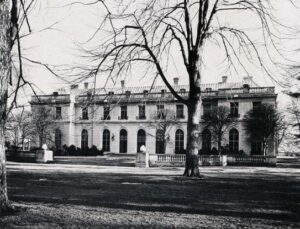
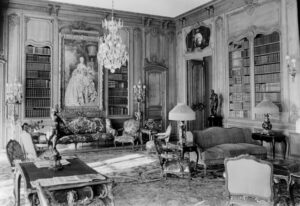

It also had fatal disadvantages: it was enormous, costly, private, and inconvenient.
After Anna Dodge died, the house sat in that dangerous interval between memory and market. People admired it. People used it for events. People understood that it mattered. There were efforts to save it. But admiration is not a maintenance plan. Sentiment does not pay for heat, roofing, staff, insurance, taxes, utilities, security, restoration, and governance.
In the end, Rose Terrace was demolished.
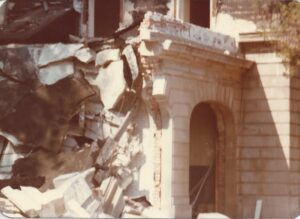
The land was subdivided.
An iconic, historically important house became a memory with a few street names—Dodge Place and Rose Terrace Street.
That is how history disappears in wealthy places. Not usually in one dramatic act of malice, but in a series of practical decisions. The house is too big. The heirs do not want it. The maintenance is too expensive. The market is limited. The land is valuable. The buyer has a plan. The municipality allows it. The neighbors regret it, perhaps, but not enough. The wrecking crew arrives.
And then everyone speaks of it in the past tense.
Rose Terrace was not alone.
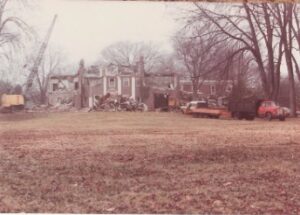
Henry Ford II did not set a good example. He owned the Roy D. Chapin house at 457 Lake Shore, a Georgian-style mansion designed by John Russell Pope, a house associated with one of the great automotive families. It was said to have had seventy-six rooms. In 1983, when his net worth was $250 million, Henry Ford II had it torn down and the land divided for condominium development. A fraction of that princely sum could have been used to preserve a legacy. Imagine—people could have visited the estates of two successive generations of Fords only miles apart. Henry died only four years later.
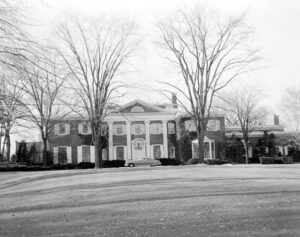
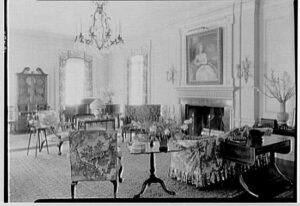

Caption: Biggest show in town—people flocked to take a last look at Henry Ford II’s Lakeshore Road home before wreckers finished the work they began last week.
That example carries a special sting.
Eleanor Ford, Henry Ford II’s mother preserved.
Henry Ford II erased.
The contrast is almost biblical in its simplicity. Eleanor Ford’s estate became the model of what Grosse Pointe could do when wealth, taste, stewardship, and public purpose came together. The Ford House today is not merely a house. It is a proof of concept. It shows that a great private estate can become a public treasure without losing its dignity. People can tour the house, walk the grounds, study the architecture, attend events, learn the history, and see Lake St. Clair not as a private backdrop but as part of a shared regional inheritance.
Henry Ford II’s decision pointed in the other direction. He turned memory into development. Perhaps the house was impractical. Perhaps the economics were punishing. Perhaps the age of seventy-six-room private houses had passed. All of that may be true.
But symbols matter.
If the Ford family itself could not consistently model preservation, why would anyone else feel compelled to do so?
That is the Ford paradox at the heart of Grosse Pointe: the same name that gave the community one of its greatest preserved estates also gave it one of its most painful demolitions.
Grosse Pointe, in this way, became a place of magnificent exceptions and depressing patterns.
The War Memorial survived.
The Ford House survived.
The Grosse Pointe Academy survived in the former Sacred Heart campus.
Some clubs, churches, and private houses survived.
But so much else vanished or remained sealed off from public understanding. It is hard to become Newport when the houses are either demolished or hidden. It is hard to become a cultural destination when the best views are private and the greatest stories are told only at dinner parties, in old photographs, in real estate brochures, or in the memories of people who once knew where the long driveways led.
For me, this is not just an architectural argument. It is personal.
I grew up with Lake St. Clair as part of the furniture of my soul. At the foot of Grand Marais, near the seawall and the cottonwood trees, the lake was not an abstraction. It was presence. It was freighters moving slowly across the horizon. It was Canada shimmering in the distance. It was blue water, bright clouds, open space, and the feeling that the world was larger and more generous than whatever trouble might be waiting back up the street.
Grand Marais was not Lake Shore Drive mansion country, but it was connected to the same spell. The lake gave the whole place its character. The old trees, the great lawns, the quiet streets, the sense of order, the seasonal rituals, the winter skating rinks, the friends on Whittier and Three Mile Road, the games, the porches, the seawall, the freighter whistles — all of it belonged to the larger Grosse Pointe inheritance.
That is why the loss hurts.
It is not merely that some rich people’s mansions were torn down. That would be too simple and too easy to dismiss. The deeper loss is that Grosse Pointe failed to fully understand itself as a place of national historical value. It had the chance to tell the story of Detroit’s rise in a way no museum in downtown Detroit could quite tell it. The factories told one side of the story. The estates told the other.
The Rouge Plant showed where the wealth was made.
Lake Shore Drive showed where the wealth slept.
Together they formed a complete American story: industry and privilege, labor and leisure, invention and inheritance, assembly lines and drawing rooms, smokestacks and rose gardens, the Model T and the seventy-six-room house.
That story should have been preserved.
Not worshiped. Preserved.
There is a difference.
To preserve Grosse Pointe’s great estates would not have meant celebrating inequality without question. Newport, at its best, does not merely celebrate wealth. It exposes it. It lets visitors walk through the ballrooms and kitchens, the bedrooms and servant spaces, the gardens and gates. It lets people see how wealth lived, how it displayed itself, how it depended on labor, how it imitated Europe, how it created beauty, and how fragile that beauty becomes when the fortunes, families, and servants disappear.
Grosse Pointe could have done that for the Midwest.
It could have said: Here is what Detroit built. Here is how automobile money changed American life. Here is how industrialists lived. Here are the architects they hired, the gardens they planted, the art they collected, the parties they gave, the servants they employed, the walls they built, and the fears they nursed. Here is the beauty, and here is the exclusion. Here is the grandeur, and here is the cost.
That would have been honest history.
Instead, too much of Grosse Pointe history has been protected from honesty by privacy. Privacy has its place. Families have a right to their homes. No one should be forced to turn a private residence into a museum simply because the house is beautiful. But when an entire region’s architectural inheritance is locked away, neglected, subdivided, or destroyed, the public loses something it never quite knew it owned.
The irony is that preservation would not have diminished Grosse Pointe. It would have enlarged it.
A public lakefront mansion district could have brought visitors, scholars, schoolchildren, architects, historians, gardeners, preservationists, and ordinary families into contact with a world they otherwise knew only by reputation. Restaurants and inns could have followed. Tours could have linked Grosse Pointe to the Detroit Institute of Arts, the Henry Ford Museum, Greenfield Village, the Ford Piquette Avenue Plant, and the great industrial sites of Detroit. The story could have been regional, layered, and magnificent.
Imagine it.
A visitor comes to Detroit to see the Diego Rivera murals at the DIA, then tours the Ford Piquette Plant, then the Rouge, then Greenfield Village, then travels out Jefferson and Lake Shore to see where the automotive aristocracy lived. The day ends on Lake St. Clair, standing on a great lawn, looking across the water at the same horizon that shaped generations of Grosse Pointe children.
That could have been one of the great cultural circuits in America.
Not Newport copied.
Newport translated.
The Newport of the Midwest.
But Grosse Pointe was never comfortable with translation into public life. It preferred being known from a distance. It preferred mystique to access. It preferred clubs to museums, private parks to public promenades, social memory to civic memory. Even now, some of the surviving mansions along Lake Shore Drive feel less like permanent monuments than hostages — held for the moment by taste, money, zoning, inheritance, and luck.
Will they survive?
Some will. The institutional ones probably will. The houses with boards, missions, endowments, memberships, donors, or public functions have a fighting chance. Private houses are more vulnerable. A devoted owner can preserve a mansion for decades, but the next owner may see only acreage, frontage, deferred maintenance, tax burden, development potential, and a buyer waiting in the wings.
That is the old Grosse Pointe story.
A house stands for eighty years.
A family name clings to it.
A gardener remembers it.
A child sees it through the gates.
An architectural historian photographs it.
A committee studies it.
A neighbor says it would be a shame.
Then the bulldozer comes.
Afterward, people say, “Can you believe they tore that down?”
Yes. By then, we can believe it. We have seen it before.
Grosse Pointe’s tragedy is not that it had no preservation instinct. It did. The Historical Society, the War Memorial, the Ford House, and other surviving institutions prove that. The tragedy is that the instinct was never powerful enough, coordinated enough, or wealthy enough to overtake the development logic.
Newport found a way to make its mansions useful after their original social purpose had expired.
Grosse Pointe too often waited until the only remaining useful thing was the land underneath them.
And land always knows how to sell itself.
Still, I do not want to end this only in bitterness. Some of the magic remains. Drive along Lake Shore at the right hour and you can still feel it. The lake still opens to the east. The trees still arch over the road. Some gates still suggest stories. Some houses still carry themselves with dignity. The Ford House still stands. The War Memorial still stands. The Academy still stands. The Historical Society still works. There are still people who care.
Maybe that is enough to keep the question alive.
What Grosse Pointe could have been is not only an accusation against the past. It is a warning to the present.
Every surviving mansion is now a test.
Every old house asks the same question:
Am I history, or am I dirt?
And every generation of Grosse Pointe answers, one property at a time.
For those of us who grew up there, who carry the lake and the streets and the trees and the freighter whistles in our bones, the answer matters. Grosse Pointe was never merely a collection of affluent suburbs. It was a landscape of memory. It was a stage on which Detroit’s greatness, contradictions, and decline could all be seen.
It could have been preserved as a national story.
It could have been opened, studied, walked, questioned, admired, criticized, and loved.
It could have been the Newport, Rhode Island of the Midwest.