SailingAds, the San Francisco Giants and Barry Bonds
SailingAds did not arrive on the scene quietly.
It debuted on Opening Day at Pacific Bell Park, the christening of the brand-new waterfront home of the San Francisco Giants—April 11, 2000.
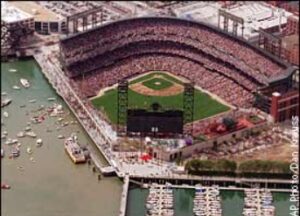
Not just any Giants.
The Giants of Willie Mays.
The Giants of Willie McCovey.
The Giants of Juan Marichal.
And so many others.
The storied San Francisco Giants, whose history had been carried west from New York and then forged anew in the cold, sometimes fog laden winds of Candlestick Park where fly balls could get lost not in the sun but in the fog—now had a ballpark worthy of the city itself. Pacific Bell Park rose beside the bay like a shrine to baseball—past, present and future. It was a celebration of the old classic style stadiums like Fenway, Wrigley and the old Yankees Bronx stadium, “The House that Ruth Built.”
Our first advertising client was an internet startup.
Opening day we sailed in McCovey Cove in front of roughly 41,000 fans, with 24,000 of them having a direct view of the cove. Inside the park, the fans were watching the Giants usher in a new era. Out in the cove and beyond the right-field wall, our thirty-four-foot Hunter sloop moved across the water carrying Esolo’s message on its sail.
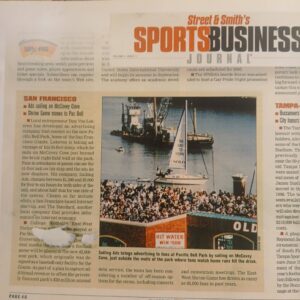
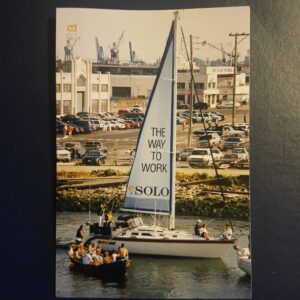
It was a day of excitement and celebration. SailingAds had gone from the drawing board to execution.
A military jet flyover roared overhead, red, white, and blue streaming from pods below the fuselages. The crowd, the bay, the Giants, the cove named for Willie McCovey, and our sail moving through the water all seemed to converge into one unbelievable moment in which:
SailingAds was not a business plan.
It was not a pitch.
It was not an idea trapped inside my head.
It was alive.
It had the wind behind it.
The idea had come to me earlier, before the ballpark was finished. Pacific Bell Park was still under construction then, rising along the Embarcadero adjacent to the water as I passed by daily jogging or riding my bike. Each time I went by, I watched the new stadium taking shape— fueling my imagination.
Something about the whole scene captured me.
It was not merely that the Giants were building a new ballpark. It was where they were building it. The right-field wall opened toward the water. That is the wall that Barry Bonds hit 160 homes runs over—35 of those landing in the cove—dubbed “Splash Hits.” The bay was not separate from the stadium; it was going to become part of the experience. Boats would gather there on the water with the fans overlooking from the inside. Television cameras would pan across it. The cove would be intrinsic to the experience.
It would be a stage.
With each visit to the Embarcadero, the pieces began arranging themselves in my mind.
The stadium.
The bay.
The boats.
The crowds.
The cameras.
The cove.
Advertising on sails.
At first, perhaps it seemed like a novelty. But it had an immediate elegance. A sailboat already carried intrigue. It suggested leisure, freedom, movement, and escape. A sail moving across the water was different from a conventional billboard standing beside a thoroughfare, trying to persuade a captive audience. An ad on a sail had grace. It could belong to the view.
Once the idea took hold, it did not simply visit my imagination. It took control of it. That is what certain entrepreneurial ideas do. They move in and start rearranging your thoughts. Suddenly every passing boat becomes evidence. Every glance toward the cove becomes confirmation. Every construction beam rising from the future ballpark seems to say, “There is something here.”
McCovey Cove was not just open water it was open space in the advertising world. Every home game would deliver tens of thousands of people to that venue. Over half of those seated in the stadium would look directly onto the cove. The cameras would find the water especially with fly balls, home runs and breaks in the action. The boats would become part of the pageantry.
And then a secret weapon appeared in my life at a 1999 corporate Christmas party, where we had been separately invited by our mutual friend Morgan (Marylou) Morgan: Marcie Powers, a high-tech public relations and communications executive who, four years later, would become my wife. I already had the sailboat and the berth at South Beach Marina. Marcie became my sounding board for SailingAds’ concepts and ideas, which I talked through ad nauseam until she finally said, “I’m tired of talking about it. Let’s do it!”
And with that, a magical partnership began—not just in business, but in life. Together we went to work putting all the pieces in place for SailingAds’ debut at Pac Bell Park on April 11, 2000.
The cove was going to have an audience.
And SailingAds could sail directly through it and capture their attention.
Before meeting Marcie I had taken the first practical step. I got on South Beach Marina’s list for a boat slip.
About six months later, that part of the equation was fulfilled.
A slip became available.
D-77.
Blown Away, a thirty-four-foot Hunter sloop was purchased from a broker in Oakland on Jack London Square across the bay. My first sailing lesson was on the day of purchase with the broker and me sailing it to San Francisco and in to its new berth.
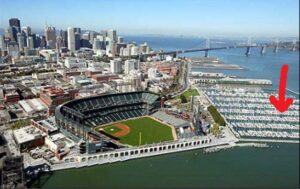
above: Slip D-77
That was the easier part. Now the idea needed mechanics.
From a distance, someone might have looked at SailingAds and thought we had simply put an advertisement on a sail. But the process was more complicated and intricate than that.
We began with durable seven-mil vinyl billboard ad material, also used for large outdoor advertising displays. The advertising pieces were designed in San Francisco and were manufactured in Texas and shipped to San Francisco via Fedex. Once they arrived, they had to be transformed from flat billboard material into something that could function on a sailboat.
That transformation took place at the Hood Sails sail loft in Sausalito.
The billboard ads were cut to sail size on the loft’s massive floor area. Velcro was sewn around the perimeter of each custom advertising panel. The ads were then attached to a $2,500 custom made permanent Velcro receiver sail.
The client’s ad became the interchangeable insert.
And the system worked on both sides of the sail.
Each side of the custom sail had its own Velcro enclosure, which meant we could sail with two different ads at the same time doubling the available advertising space.
When there was little or no wind—which was rare—we were engine powered.
Pacific Bell Park was opening. McCovey Cove was about to become part of the mythology of San Francisco baseball. The late 1990s had turned the word “dot-com” into a kind of magic spell. Companies were being born out of names, initials, concepts, and optimism. Add “.com” to almost anything and people leaned forward. The improbable became fundable. The untested became visionary. The future felt like it was being invented daily.
SailingAds belonged to that atmosphere.
While so many companies were chasing eyeballs online, SailingAds was chasing eyeballs in the real world—in one of the most visible waterfront settings in America.
Mechanically, it was advertising material attached to a sail. Emotionally, it was something else. It was a message carried by wind. It was commerce moving through scenery. It was an advertisement that did not feel like an intrusion because it belonged to the water, the boat, the cove, and the spectacle.
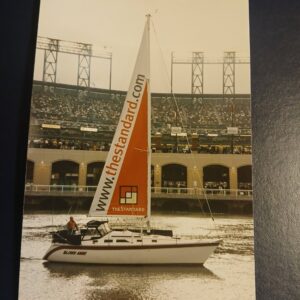
During that first year, we secured more advertising clients, including two juggernaut Internet magazines of the dot-com era: The Industry Standard and Red Herring. In those years, those names meant something. They were not obscure publications. They were part of the nervous system of the Internet boom, read by entrepreneurs, investors, executives, technologists, and everyone trying to understand where the future was heading.
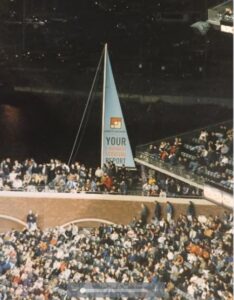
above-sailing the Industry Standard ad: sailing the boat right next to the stadium wall the sail looks like it’s in the stands.
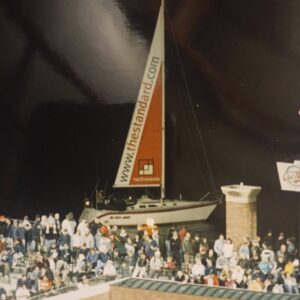
above: the other side of the sail with an Industry Standard ad
For SailingAds to carry their messages in McCovey Cove gave the venture legitimacy. These were not sleepy local advertisers buying a cute novelty placement. These were brands attached to the gold-rush psychology of the age.
In our contract with The Industry Standard, we were paid $24,000 for an eight game engagement—sailing in and out of McCovey Cove.
They received an unexpected bonus during one game when their sailing ad was featured on national television. On May 24, 2000, Barry Bonds launched his fourth career splash hit—one of 35 he would ultimately send into McCovey Cove—and the SailingAds boat was caught in the national highlight reels as the ball splashed into the water.
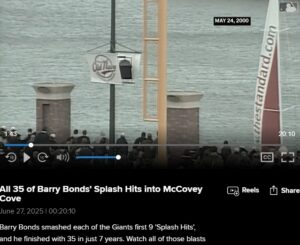
Click on above for video of all of Bonds Splash Hits…
It proved the concept had value.
A business had written a substantial check and we were getting buzz.
And yet there was a cruel irony at the heart of it all.
The very stage that made SailingAds possible did not exist until the market that should have fed it was already beginning to collapse.
Pacific Bell Park did not come online until April 11, 2000. McCovey Cove, as a public advertising stage, did not exist before then. Yes, the water was there. The bay was there. The idea could be imagined. But the essential theater — the new ballpark, the fans looking onto the bay and over the right-field wall, the television cameras finding the cove, the boats gathering beyond the fence — all of that depended on the Giants opening their waterfront home.
That was the sad reality.
Had this same venue existed in 1998 or 1999, the story might have been very different. Hundreds of dot-com companies were then competing for attention, legitimacy, visibility, and buzz. Their advertising budgets seemed almost limitless. Their appetite for novelty was enormous. Every startup wanted to look inevitable. Every brand wanted to be seen. Every company wanted to attach itself to the feeling of the future.
A logo sailing through McCovey Cove beside the brand-new home of the San Francisco Giants might have been irresistible.
But Pacific Bell Park was not there yet.
McCovey Cove had not yet entered the public imagination.
Our stage arrived in April 2000.
And by then, the dot-com bust was already in full motion.
The timing was almost Shakespearean. The perfect venue appeared just as the perfect advertising market began to disappear. The companies that might have filled our sails were suddenly watching their stock prices collapse, their venture funding dry up, and their advertising budgets come under pressure. The fever was breaking almost exactly as we came out of the gates.
We had the right idea.
We had the right location.
We had the right visual hook.
We had the right cultural moment in San Francisco baseball.
We had clients who proved the concept.
What we did not have was the luxury of an earlier ballpark.
The door opened at the same moment the gold rush began to end.
That fact matters because it keeps the story honest. SailingAds was not merely a fantasy. It was not just a stunt. It was not some late-1990s business daydream that evaporated the moment it met reality. It launched on one of the great civic and sporting days in San Francisco history. It had a boat. It had a slip. It had a system. It had clients. It had contracts. It had revenue.
What it did not have was timing.
Or rather, it had the most exquisite and painful timing imaginable: the perfect venue arriving just as the perfect market was losing air.
And later came the recognition that our business had been born at the hinge of an era.
Behind us was the dot-com boom, with its extravagant faith, its open checkbooks, its hunger for attention, and its belief that the future could be branded into existence.
Ahead of us was the bust, with its shrinking budgets, failed companies, collapsing valuations, and sudden fear.
SailingAds arrived exactly between those two worlds.
Our sail caught the last bright gusts of an era.
is proudly powered by WordPress