Before He Died By His Own Hand
Several years before his death, my nephew Matthew sent me a collection of writings describing his experiences at Mount Hope. The passages that follow are drawn from those writings and provide his own firsthand account of life inside the commune.
The Author of this Book (his Uncle Tom)
wishes to share those writings as Matthew would have wanted.
Rats are an interesting animal, don’t you think?
As a culture, we tend to demonize them, consider them exclusively related to filth and squalor, homelessness, and gnawing. Trash. Grime. Nasty. Underground….
And, most certainly, they are a lower animal—base, profane, dirty, even filthy. Strangely, many children have them as pets. And, they could very well be essential to the recycling process, renewal, sustainability, as such.
I had two interesting encounters with these decidedly alienated creatures at the commune. I’m not sure which came first, but they were both mortifying in their own way. Ah, yes—death—that may be the other association I was having to rats. Death.
Anyway, for some reason I had been designated the “horse kid” at the commune.
At about the age of 8—until I had found that I possessed a determined, instinctual quality of sniffing out the opposite sex and also became acquainted with a way to parlay my basketball skills into a viable way to gain respect in the outer world—I was bestowed the roles of riding, cleaning, and maintaining the 5 horses that the commune owned.
Not by myself, of course.
There was a trainer, who in fact looked a lot like a combination of a handsome, fit thoroughbred and a skinny walrus, as well as a large, highly discriminating, nurturing and intelligent woman. A rough, but fair mother-type. Funny, she never had kids as far as I know.
But, basically, the job was mine.
You see, in effect, everyone—and I mean everyone—had a role at the commune.
It was as if Dr. Schwartz was the Francis Ford Coppola in the sky and each actor played his or her part to the designated perfection of the boss or there was hell to pay.
Well, the problem with me was, I played my part too well. Way too well.
I was trained three days a week by this man who eventually went on to coach in the Olympics, and soon enough was entering shows throughout the Tri-State area. Well, being the hypervigilant, perfectionistic, and flawless first born that I was (even then, especially then), I was bringing home little blue ribbons and the occasional silver bowls in short order.
It felt great. Really great.
And, you know, it’s not as if I was getting too “high on the horse” (I couldn’t resist) or anything.
After all, in the dead of winter, after doing my chores, and my homework, I would walk up the hill, about a ½ mile, ice crunching beneath my feet, in the pitch dark, and I would clean the stalls. All five of them.
I would pitchfork the shit into a wheelbarrow, find the clods of piss, and refresh the hay, as well as feed these noble animals.
I’m not complaining.
I found myself loving these sensitive, intuitive animals more than any human in my life. In fact, I would, on many occasion, lie down with Traveler or Milky Way, and it was as if I were within the arms of Nature itself, safe from the grip of confused and hypocritical humans.
So, one December night, I’m up in the barn working away, carrying the buckets to retrieve some fresh oats in the tack room, and I walk into the saddle office where there is a small radiating heater—you know, those kinds that have the orange glowing wires in them.
I stop at the feed bin and begin scooping up the horse food into the bucket.
Well, to my shock, something moves in the bucket of oats.
I’m, needless to say, thrown back on my heels. After all, it is the dead of winter, not a sound in the thick, frigid air, and not a human soul around.
So, I go into investigation mode. I get a small stick and begin digging down, and within a few minutes I have uncovered 5 small, pink and furry animals.
They resemble a small cluster of not-yet-ripened strawberries dipped for a second in milk chocolate.
Well, being the inquisitive, compassionate, and determined little boy that I was, what did I do?
I ran and found a soiled white towel we had used to dry off the horses, wrapped the little baby animals in the towel and placed the towel at the base of the portable heater.
Then, I went back to work on the horse stalls.
So, the next day, I am eating a bowl of french fries with the rest of the kids after school and I’m greeted by Sister Gerry—the Carmelite Nun from Hell.
Well, I’m thinking, “It’s about time. I’ve been a stellar scholar in school, a perfect gentleman in my relations with the other children, I do everything asked of me and a most stellar kickball player.”
Good try.
She softly—and even seductively—grabs my arm and proclaims, “Herbert would like to see you.”
Ah, shit. Not again?
Ok, so the rites of soul-cleansing are over after an hour in his cave of ill repute and sadistic pleasures, and I’m out in the Big House on a 72-hour “work detail/silent treatment.”
So, following the abstract art session where the Chinese letters were tattooed on our backsides by a 52-inch belt, we were typically given additional help in absolution.
Sometimes it was 10 Hail Marys. Other times, a simple apology. However, typically it would be something they referred to as “work detail.”
Work detail was basically a 10-hour job—or series of jobs—usually of the highly humiliating level issued by Pat Byrne. We jokingly referred to them as PBJ’s, an acronym also designated for another delicacy of the commune – peanut butter and jelly sandwiches,.
Now, the “silent treatment” was even more harsh as far as I was concerned. This entailed no one speaking to you and you saying not a word to anyone for the length of the sentence.
Well, the two combined were quite an experience.
I am handed a Brillo pad, a pail of water, and a roll of paper towel.
I am to scrub down the radiators which run the whole perimeter of the building. There must have been 2½ miles of metal to clean, and not knowing my transgression (I couldn’t speak to anyone), I’m thinking the worst.
And I was right—it was horrendous. These things hadn’t been cleaned in years.
I think it took me about 3 days.
And, boy, those heaters were shining. I could swear that the Big house was 10 degrees warmer that winter as a result of my recompense.
So, I’m invited back in to see Herbert again, and I don’t even care at this point what I did to earn such a job. I just want to show the proper remorse, be bestowed his blessings, and get on with living my life.
So, I’m standing there, and he gestures me to give him the customary “We’re friends, right?” hug, and reluctantly, I lean down.
Jesus.
He always smelled like a combination of four-day-old piss, stale bagels, and rotten smoked salmon. Always. That same putrid smell.
But, I lean down anyway, hug him, he pats my head, and asks me if I am sorry. With my most pathetic and best imitated martyr of a face, I nod.
He then hands me a string of imitation cherry candies and a dollar bill and dismisses me.
No comment on the crime. No discussion.
Well, an hour later, as we are getting ready to go off “the reservation” to some park, I begin to get curious.
And indignant.
Something inside of me is saying, “Hold on. This is kind of fucked up. I didn’t even do anything.”
And then I did all of that work—for what?
We’re riding in the back of the tan Suburban, and I lean over and consult my trusty older friend Ricky, a young man who always seemed to possess the wisdom to keep his head low and out of harm’s way
So, I whisper, “Do you know why I had to have work detail and the silent treatment?”
He shakes his head, as if to say, “Shhhh.”
I persist.
Finally, he leans over and whispers in my ear:
“You fed those rats, idiot.”
I was bewildered. A little in shock, to say the least.
First of all, I had no idea they were rats. I suppose I was just following my instinct that these were babies—vulnerable little ones at the mercy of the elements and whatever else was out there lurking in the darkness.
Secondly, I was thinking that—shit—that time didn’t fit that crime. No way.
In any case, I realized then and there—and I probably ought to have sooner—that the blows could come swift and hard, even brutally, and that you very likely might never know what precipitated it.
There was another, quite different experience with rats, perhaps a few years later.
You see, 220 humans can generate a lot of garbage. Especially when recycling and “sustainability” are not quite yet in vogue.
As a result, Herbert had a few men construct an area—essentially a fenced-in and quarantined space—approximately 25 by 40 feet. It was about 50 feet from the back door of the Big House, a direct line from the industrial-sized kitchen.
Well, a certain type of ecosystem took hold in the trash area after a few years and, as a result, an extended family of rodents seemed to take the property on as their home.
One year—maybe it was around 1977—I’m working the dishwasher machine, which was this huge monstrosity of a machine, the size of a Volkswagen, and housed in this tiny room that would easily hit about 120 degrees in the summertime.
The older boys were always making deals to give me their lunch or dinner slots as the dishwasher, as they knew I had something to prove and would happily try and please them by saying yes.
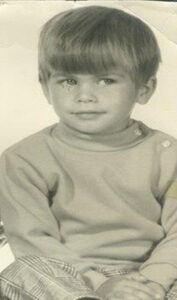
In fact, there exists somewhere—perhaps in my mother or father’s possession—a picture of me, with my hair to my shoulders, wearing a Woody Woodpecker T-shirt, grinning broadly, crooked teeth askance like a giddy jack-o-lantern, barely peeking over the window which looked into the community room of the Big House.
I could barely lift those heavy green plastic trays of plates or pots to deliver them to the two or three drying people, and yet I took it on because it made me feel like one of the guys, and it seemed like a big, important job at the time.
So, I’m there, and this machine is churning away, rinsing all of the nasty commune grub from the plates and silverware, and I’m just humming along—perhaps singing a Tom Petty tune like you don’t have to live like a refugee—and all of a sudden, I see, out of the corner of my eye, a platoon of men rushing by the door.
That door.
It was the door of responsibility, and on some level one of the couple of doors of initiation into manhood (the other was a short stroll around the corner—the entrance to Herbert’s room) that I would walk through on a daily basis.
But it was also the door where I would do this trick—you probably know it. You stand in the open doorway and press your hands against the door frame as hard as you can for about three minutes. Then, what I would do is let go, and my arms would naturally rise as if I were an angel growing these majestic wings, and I would close my eyes and fly high over the fields and buildings out of the great compound we were imprisoned on and beyond the suffocating rules and pious religious reasonings, and over to New York City where I could find my true family—whoever and whatever they were.
Chkkk—Shkkkk!
Whoa.
I’m back again, and these men are running to the rear of the house, beyond the stocking pantry where I would steal Twinkies when I knew no one was looking, and out the back door with shotguns cocked.
So what do I do?
I hit the emergency red button, putting the “VW” into a dead stop, and I run after them.
Dirty dishes be damned—they can wait. I’ll take another whipping if I have to.
Something big is going down, and it’s in the opposite direction of Herbert’s room, on this most rare of occasions.
Well, no luck.
I’m stopped in my tracks by one of the kitchen staff and sent to the back window to observe—but this was good enough.
In what seemed like some localized version of Armageddon (certainly a “world destruction fantasy” wish on my part), five or six shotgun blasts erupt and furry, brown, and bloodied carcasses are doing backflips through the robin’s-egg blue sky.
It was phenomenal.
The excitement, mayhem, release, and destruction were like some other-worldly apocalyptic scene from Mad Max or something.
I stood at that window as more and more people came and layered on top of me to get a better view of the chaos.
Those five men must have felt like heroes—eradicating those villainous and vile animals that were disrupting their pristine, spiritual utopia.
I know this because, an hour later, I saw them march into Herbert’s room and declare their victory.
It may be the only time that I saw some type of pride or virility from those men, who seemed to possess a certain internal absence and loss of spirit on a daily level.
This incredible juxtaposition had never occurred to me before this writing—the strange interplay of life and death, when it was right to kill, and when it was wrong to save a life.
Blue Toes and Belts
In all of the footage of the Dalai Lhama and Tibetan Buddhism I have ever heard or seen, two episodes have impacted my imagination the most.
The one is something his Holiness said when inquired by a BBC interviewer on the occasion in which he was asked how he felt about the Chinese.
I was sitting there, expecting to finally see the DL show a little anger, you know—let his true feelings show for once—considering he was there when they came and took over his country and slaughtered and brutally tortured thousands of his people.
His people. His religion. His home.
Nope.
What he said was—this was after he leaned his head back and chuckled—“Well, the Chinese; they are our greatest teachers.”
I don’t remember the rest, but it had something to do with our enemies teaching us compassion. You know, some type of spiritual evolution very distinct and a bit different from the Old Testament law, “an eye for an eye.”
As a boy, growing up in the “spiritual” environment that I did, I suppose I should have been able to adopt or learn such a high-minded principle, but I must admit, I still am not there.
I have a bit of trouble with forgiveness, much less seeing my transgressors as teachers.
Anyway, for a time at the commune, it was a ritual every morning where the kids—it seemed there were about 25 or 30 of us—would, upon awakening and before breakfast, have to line up at Herbert’s feet and give him a hug and receive some type of “blessing” before the day began.
Now, having children of my own, I find that the converse is much more apt.
It is far more a blessing for me, from my sons and daughter, that I receive just being in their presence. I couldn’t imagine, in a million years, having them receive a blessing from me.
How absurd.
Anyway, after the months of smelling his pissy wool blankets and being pressed against his groin, my comrade Michael—a truly fearless and foolish boy by most standards—whispers something to me.
I turn around and gesture that I didn’t hear him. Of course, one of the nunly women supervising us gives me “the stare.” I militantly turn and face forward.
So, he says it again.
You see, Michael was relentless—and paid for it dearly.
This time, I hear him, though.
He, with this supremely devilish grin on his face, says something to the effect of, “His toes are blue, and I am going to pretend to trip.”
Well, naturally, this throws me into a panic.
In fact, having Michael as my one and only age-same peer there was like always being on one of those gravity rides at the carnival. It was a rush—always on the brink of throwing up, hypervigilant as to the dangers involved, and unable to escape.
So, I turn around and shake my head violently.
Violently.
I know that if this goes down, as much as I would like to stand there and watch this debacle as I took leave smelling of Herbert’s urine-soaked groin, that it would come down on all of our heads.
No one would be spared.
This, I knew.
Well, needless to say, I’m trembling from head to toe as I get up there and reluctantly wrap my arms around Herbert’s huge belly.
He absent-mindedly pats my head, and I peek down at the little strings which hang off of his Pendleton blanket.
Sure enough, his left foot is hanging out, and three of his toes have this greenish, bluish tinge to them.
So, I turn and take leave, reciting a Hail Mary that Michael wouldn’t follow through, while knowing full well that he would.
I slightly turn my head in the direction of Michael, hoping against hope that he will rethink this.
Of course, another part of me is going, “Brilliant. It’s about time we found some way to pay this bastard back.”
Well, sure enough, he’s looking at me out of the corner of his right eye with what, I swear, is a twinkle.
Within moments, I hear a sound that perhaps I have only heard hiking through the tobels around Zurich or the headlands of Northern California.
It was purely primal.
And, needless to say, all hell breaks loose in the wake of it.
In fact, this happens a lot—that hell frequently breaks loose where there is an attempt to create some type of heavenly utopia here on Earth.
Check that out. It’s true.
Anyway, the expected happens yet again.
You see, after a few years I could anticipate some of the consequences when I was in that rarified air of Herbert’s presence.
For instance, there was a day—I was about 10—where the older kids and some of the adults were invited in to make models, you know, those plastic airplanes and cars where you would need an exacto knife and some special kind of glue.
So, we are all sitting around on two-day-old newspapers, in the presence of the master “model-maker,” if you know what I mean, and I need some glue.
So, I carefully and silently stand up, gingerly walk over to the cabinet that holds the supplies.
I choose this old Gerber baby food jar and pick it up from its top.
I pivot and head back to my spot on the floor, my B-52 waiting for its construction to begin.
Within five paces, one of the worst moments of my short life occurs.
The jar comes loose, hits the carpet, and glue is everywhere.
I look down, mortified, because I know that that glue puddle won’t be the only one on the carpet in a short time, knowing full well that I will be peeing my pants as the room is cleared for my punishment.
Ok, so back to Herbert’s toes, and the aftermath of Michael’s shenanigans.
The children are all marched out of the room, and a private consultation is called with the commune physician, the two women who acted as Herbert’s consultants, and the nuns who were supervising us.
In quick succession, we are all in a line which points in the direction of one of the two bathrooms in the Big House.
I think it was the yellow one. The other one was green.
As we wait, anticipating the inevitable, a new guy—one who I had never had the pleasure of meeting with his distinct handling of the strap—walks by.
I’m thinking, now, that this could be a good sign.
We may get off easy.
He doesn’t have any experience at this, and how did he get this cherry job anyway?
Well, old Kevin, it seems, had something to prove in his inaugural debut, and we got it worse than ever before.
In fact, the next morning, as we are taking a shower together, Michael and I began what was to be a periodic ritual where we would turn around for each other and compare the black-and-blue welts on our asses and upper backs.
I could never see my own, of course, but I can say with the utmost honesty that Michael’s resembled some bizarre and perverted form of raised Chinese calligraphy.
It was neither graceful nor beautiful.
So, the second image I have of the tragedy in Tibet is from some Hollywood movie, however it was authentic footage.
I checked.
In the video, after the Chinese had invaded the area of Tibet near Lhasa, a succession of monks are made to kneel on the ground, stoically accepting their fate.
And then, like a flash of lightning, one of the monk’s faces contorts with absolute anguish as he is handed a revolver and demanded to shoot an elderly monk next to him.
The scene goes on for a matter of minutes, ending in the younger monk shooting his brother in the head and collapsing—I imagined—dead from a shattered heart.
Of course, I have never experienced anything on that scale, but I can say that I know the feeling of having my heart shatter apart as a result of a similar scenario.
When I was about 12, my mother was instrumental in influencing Herbert enough where he announced a commune-wide decree that the families with younger children were to reunify and relocate to houses the foundation had acquired on the outskirts of the commune.
Prior to that time, when we had arrived, we were placed in a building with older boys and men—my sister with girls and women.
This had its consequences, as you can imagine.
As a result, to my great joy, we lived at a big gray house about 4 miles from the compound, inhabiting it with, I think, 4 other families.
I loved it there.
Well, of course, a whole new logistical scheme had to be created out of the necessity that the kids got to their new homes after school and their chores and such.
So, they purchased two large Chevy Suburbans to cart the kids around who lived “off campus.”
One day, Ricky—who I had mentioned before—and I are riding in one of the big cars.
He was my one role model there and about 4 years older than me.
I loved Ricky.
So, he and I are assigned to keep an eye on the younger kids and keep them in line as we are driven to the gray house.
No problem, right?
Well, my sister and her little friends—they must have been around 7 then—are carrying on in the back, and we “shush” them a couple of times, haphazardly.
We knew they were having some harmless fun, just letting off some steam after a tense day at the commune school, where most of the time one could hear a pin drop, if not the sheep in the pasture behind us “bahhhing.”
After a couple of miles, the person driving—who I can’t remember for the life of me—yells at the top of their lungs:
“Shut up!”
Silence.
No sound for the rest of the ride.
I go home for the night thinking that another day had successfully been endured.
That is, until Ricky and I are called into Herbert’s room the next day.
Then, it was the Grand Inquisition.
And just as useless—full of pomp and circumstance.
Herbert wants to know why we didn’t do our jobs, much less rightly.
I defer to Ricky, him being the elder.
He shrugs.
Herbert then asks for all of the kids who were in the vehicle be found and brought in for questioning.
As well as the driver of the Suburban.
So, as Ricky and I stand there awkwardly, fearfully, with our hands in our pockets for about twenty minutes, Herbert goes on about his business picking out his sheet music for the following morning or something.
All the while, Ricky and I catch glances out of the corner of our eyes—ones of pure bewilderment and anxiety.
Then, in walk my little sister, my brother, and the cadre representing the 7–9-year-old age group.
They are thoroughly confused—maybe even a bit giddy—looking longingly into my eyes as if they hold some secret knowledge as to what’s about to go down in this most dangerous of zones.
So, we are all standing there wondering what’s going to happen next, and the buzzer goes off next to Herbert’s chair. It was the que that someone was pushing the red button in order to gain admittance. The door is opened and in walks the two Frenchmen. Now, we’re fucked!
But, the absolute unexpected happens.
One of the henchmen is handed the belt, and Herbert tells him to hand it to Ricky.
Now, I’m really confused.
Then, I hear what has been one of the most disturbing and defiling suggestions I have ever heard in my life.
Herbert instructs Ricky to whip the younger kids.
And that I will help.
We all just stood there in shock.
As the two Frenchmen are getting the bed ready for this most exciting of rituals, the younger ones are lined up and Ricky and I stand on either side of them.
My brother is first, and Ricky starts to whip him, and I can tell he’s holding back.
So, I’m praying that the two aren’t noticing.
They are.
After about three mild lashings, I hear Herbert speak:
“He’s sparing them; maybe he should try it on Matthew.”
Wow.
This was getting twisted in a hurry.
So, in swift order, I’m prone on the bed, and Ricky is giving it to me good.
Never as hard as those other guys—but it stung, I’ll tell you.
And then, once we learned how to more properly traumatize and torture our younger brothers and sisters, we alternated.
It may have been the absolute worst day—and there were many—of my life.
When my little sister’s turn came up, I didn’t necessarily scream in agony like that monk.
But I do distinctly remember shedding a tear or two.
Something I continue to do to this day when I think of her.
Matthew David Van Lokeren 8/26/64 – 11/19/13 RIP my beloved, sensitive, wonderful. loveable nephew