They began before dawn.
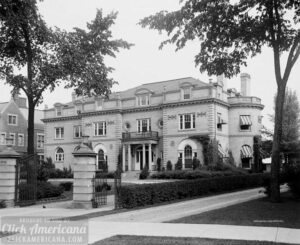
Not with spectacle, but with precision. Ladders leaned into cold limestone along East Jefferson Avenue near downtown Detroit with cranes hovering above, and men worked quietly, methodically, as if they understood they were not tearing something down—they were unwinding it. 8129 E. Jefferson in Indian Village, built by John B. Ford and designed by Alpheus Chittenden, for twenty-five years since 1903 the 10,500 square foot stone home had stood there, solid and assured, a monument to Detroit’s rising fortunes.
Now it was being taken apart.
One block at a time.
Each stone was marked. Catalogued. Carried away. Nothing discarded. Nothing forgotten. The house was not being destroyed—it was being prepared for its next life.
By the late 1920s, Detroit’s center of gravity had shifted. The families who built their fortunes along East Jefferson were moving east, toward Grosse Pointe and the open shoreline of Lake St. Clair. Toward air, and space where life took on a different rhythm.
Most built new.
This one did not.
Instead, the decision was made by Frederick Ford, the heir and son of John Ford—quietly, deliberately—that the home itself would go. Not a replica. Not a memory. The home. One might assume that Frederick loved that home he grew up in and obviously could afford to take it with him.
And so it left the city the only way it could—disassembled, limestone block by limestone block, piece by piece, carried by truck through the streets that had made it possible, until it reached Windmill Pointe Drive in Grosse Pointe Park, where a new foundation waited at the edge of the lake.
There, the process reversed.
Stone met stone. Lines re-formed. Openings became windows again. And slowly, almost improbably, the house returned—facing a different horizon now, still facing Canada but further away and carrying the same weight of origin.
A Detroit home, reborn on the water.
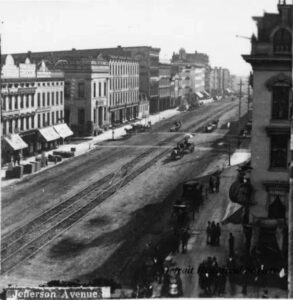
Before it faced the lake, it faced the river.
The Ford mansion on East Jefferson Avenue in Detroit, circa 1904—years before it was taken apart and carried east to Windmill Pointe.
Nearly four decades later, it found us.
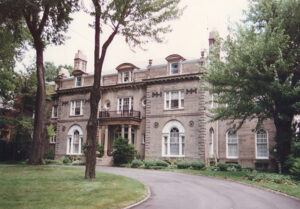
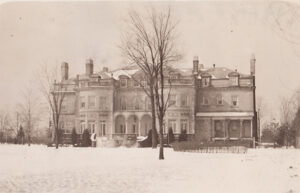
A Detroit home, reborn on the water.
Reconstructed on Windmill Pointe, Grosse Pointe Park—its second life facing Lake St. Clair.
My parents bought the mansion at an IRS tax auction in 1966—an ending for someone else, a beginning for us. I was a child of 12 then when we landed inside something vast and improbable—for me an absolute wonderland ready to be explored and have its secrets revealed.
For twelve years, it was simply home.
But even then, the home had a way of reminding you that it had lived another life.
The ceilings were impossibly high, the kind that swallowed sound. Footsteps didn’t just echo—they lingered. Doors were heavy, deliberate things, closing with a finality that felt older than us. In winter, the lake wind would press against the windows and the sound would move through the house in a low, steady whisper, as if it were trying to find its way through rooms it hadn’t yet memorized.
The forty foot ceiling with brass chandelier in the foyer announced its past. There were hallways that seemed to go on longer than necessary. Rooms for every purpose off those hallways. Corners where the light came in at an unusual angle.
And yet—
it was never cold.
For all its scale, the home carried an intimacy that most mansions never achieve. The carved woodwork softened everything—the walls, the moldings, the fireplace mantels worn smooth in places you couldn’t see but could somehow feel. Several sets of french doors opened onto the spacious lake view veranda flooding the interior with light.
It held you differently.
The rooms didn’t overwhelm; they gathered. The details—hand-cut, deliberate, human—pulled the space inward, made it knowable. It was a home built by people who expected to live inside it, not just be seen in it.
As a child, I didn’t have the language for that balance. I just knew that I could disappear into it and still feel found.
But the house did not live quietly.
At times we opened it to the world.
There were nights when the rooms filled with music and people, when the formality came alive instead of sitting still. My brother Michael and sister Mary Alice were married there in epic fashion—moments when the house seemed to understand its purpose, gathering family and friends into something warm, ceremonial and lasting.
Once, the Detroit Symphony gala marked the opening of a season within its walls. The same rooms that held our everyday lives collected iconic memories.
And outside—on the back lawn facing the lake—the world would arrive in stranger ways.
Film crews. Equipment. Lights.
A Ford commercial was shot there, the kind of thing that turned the familiar into something staged and surreal. I remember one in particular—a Cougar ad. Not just the car, but the animal itself. A real cougar, on a leash ready to mount the roof of the car for the shoot.
Even then, it felt improbable.
And then there were the nights that belonged entirely to me.
After high school basketball games, it could begin with almost nothing—a whisper into an ear on my left, another on my right. No announcement. No plan. Just the quiet ignition of something that would take on a life of its own.
By the time I got home, the street would already be filled.
Cars lined up along Windmill Pointe—many dozens of them, stretching farther than seemed possible. Headlights cutting across the dark, car doors slamming, voices rising, the energy of it building before I even stepped inside.
And then the house would take it in.
Up and down the steps of the grand staircase that divided left and right, then folded back above you, in room after room, hallway after hallway, filling not with ceremony or orchestration, but with youth—loud, spontaneous, alive. The same spaces that had held symphony galas and weddings now held something looser, less controlled, but no less real.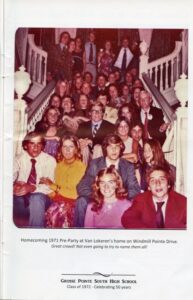
Above: 1971 Homecoming Dinner
Of course my parents were on a trip.
And yet, somehow—
nothing was ever broken.
Nothing stolen. Nothing damaged. Not once.
Looking back, it’s hard to explain. Gatherings of that size, that unstructured, should have left its mark. But it didn’t. It was as if the house itself set the terms. As if its presence—its history, its weight, its quiet authority—demanded a kind of respect that didn’t need to be spoken.
Even in chaos, it held the line.
It was in this writing that a sweet irony revealed itself.
My father had made a good portion of his living with multiple enterprises along the five mile East Jefferson corridor from Grosse Pointe to downtown Detroit—the very stretch where the home had once stood in its original incarnation. His work traced that road daily, moving through the same geography the mansion had once occupied, long before it was taken apart and carried east.
He built his life along the path the home had left behind.
And then, somehow, he became its owner.
Not the builder. Not the first inhabitant. But the one who brought his family into it after it had already crossed from one world into another.
There was something in that I couldn’t ignore once I saw it. Something that felt less like coincidence and more like convergence.
As if the home had made its journey once—
and then waited.
It had been a home, a stage, a monument—
and somehow, for a time,
it was ours.
Click on Back to Contents below to get to the full book.