Inspired by a good friend who had gone busking through Europe in the mid-1970s, I decided to develop an act I could take to the streets.
My friend Muggs with his acoustic guitar was expert at covering Bob Dylan and The Beatles. He had an attractive girlfriend named Dagmar who schmoozed, smiled, and passed the hat among the crowds on street corners, in town squares, and wherever else they could gather an audience. I believe Muggs told me he had performed in thirty-nine countries over a period of a few years.
To me, that sounded like freedom itself.
After I graduated from college, I planned to eventually go to Europe and visit my relatives from the old country in Belgium. I wanted those two months to be eventful. I wanted something more than museums, postcards, youth hostels, and the obligatory snapshots in front of historical buildings. Muggs had given me the model: take something you could do, take it to the street, and let Europe happen around you.
I knew how to pick a five-string banjo, Scruggs bluegrass style. I also knew how to ride a unicycle.
So I decided that combination was my best shot in the world of street performance.
It took me a couple of months to be ready for prime time. Riding a unicycle by itself is one kind of foolishness. Playing a banjo by itself is another. Doing both at the same time required a special willingness to appear ridiculous before becoming even briefly competent. But I practiced until I could stay upright, pick my way through a tune, and not injure myself or innocent bystanders. In the process I believe the last count of destroyed seats was four as the seat would come crashing down to the ground when I lost my balance.
In June of 1979, I set out for Europe, landing in Brussels with a backpack, a unicycle, and a Fender banjo.
My first performance was on a cobblestone street in Brussels’ historic district near the Grand-Place, that magnificent town square whose roots reach back to the eleventh century, with many iterations since. It was the sort of place that made an American boy feel instantly underdressed by history. The stones beneath me had outlasted empires, wars, kings, merchants, armies, and now a banjo playing fool on a unicycle.
At first, I was tentative. I found a spot where I hoped I would not obstruct foot traffic, tuned the banjo, climbed onto the unicycle, and began to pick. People slowed down. A few stopped. Children stared first. Children are always willing to grant a performer his first audience if there is any chance he might fall down.
Then adults gathered. Currency appeared. Smiles appeared. I had crossed some invisible line from oddity to entertainment.
I would eventually perform in the Grand-Place. The first night turned into a one-ring circus.
I started my act and the crowd grew. Then along came a juggler, who jumped into the action as if he had been scheduled all along. A few minutes later, a mime showed up. He, too, slipped into the act without invitation or permission. Later, believe it or not, a commercial airline pilot approached me and said he knew his way around a banjo. I handed the instrument over to him, and he blew the crowd away with his Bluegrass renditions.
He was better than I was.
Before long, we had about a hundred people assembled around us, having a grand old time, clapping hands and stamping feet. There was no producer, no permit, no stage, no program, and no explanation. There was only the strange chemistry of street life: a banjo, a unicycle, a juggler, a mime, a pilot, a crowd, and the old stones of Brussels giving us their blessing.
It was euphoric.
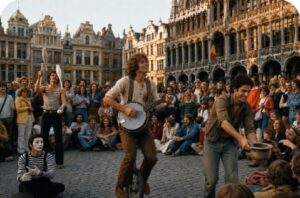
Above: a rendering based on memory
I spent two weeks in Brussels. One evening I was approached by a young man named Dror, from Arad, Israel. He had just finished his mandatory three-year term in the Israeli army and was now on holiday, ready to let the good times roll.
Dror saw opportunity in me.
More accurately, he saw opportunity in the act. Opportunity to make some local coin. Opportunity to meet girls. Opportunity to turn my little solo enterprise into something more efficient.
His pitch was simple.
“By the time you finish your act and pass the hat, half the crowd is gone,” he said. “You could put more in your pocket by having me pass the hat while you’re riding and picking—even if we split the pot.”
It was a brilliant observation. I had been doing everything in sequence: perform, dismount, smile, pass the hat, hope the crowd remained generous before it dissolved. Dror understood the economics of immediacy. The emotional peak came while I was still riding and picking. That was when the hat needed to move.
I gave it a go.
He was right.
Dror and I took the show to Paris.
For the next two weeks, Dror and I were a team. I rode and picked. He passed the hat. He had charm, nerve, and a certain directness that did not apologize for asking strangers to reward what they had just enjoyed. We generated enough money in three or four hours to pay for the day’s lodging, food, and entertainment
That formula was entirely unforeseen.
I had gone to Europe with a backpack, a banjo, and a unicycle. I had not foreseen a business model.
Paris was a different stage altogether. Brussels had given me cobblestones, charm, and a kind of old-world tolerance. Paris offered grandeur, crowds and an electric atmosphere. The city was beautiful, but it did not feel innocent. It felt watched over. It had rules, even when you did not know what they were.
In general, busking was tolerated if you chose your spot with common sense. If you weren’t blocking foot traffic, you could usually play until you wore out your welcome, gathered enough coins, or simply moved on. There was a rhythm to it. Pick a corner. Read the pedestrians. Stay out of the flow. Do not overstay. Move before someone with authority decided you had become a nuisance.
But one night in Paris, we were not merely shooed away.
We were rounded up.
The French police appeared with that particular official confidence that makes conversation feel pointless before it begins. One moment we were street performers working a crowd; the next we were a public-order problem. The banjo, the unicycle, the hat man, the coins, the laughter, the whole harmless little traveling circus had somehow crossed a line we had not seen.
There is a special helplessness in being arrested in a language you do not totally command. You can shrug. You can protest in fragments. You can attempt to explain that you are not a criminal, merely an American on a unicycle with a banjo. But such explanations do not always improve the situation.
We were bundled into the Parisian version of a paddy wagon—a panier à salade—and hauled off to the police station.
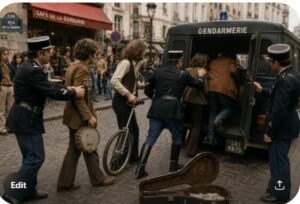
Above: a rendering based on memory
The phrase itself was almost too good to be true. Panier à salade literally means “salad basket,” and in French slang it refers to the police van used to haul people away. Had I encountered the phrase in a novel, I might have thought the writer was trying too hard. But there we were, tossed into the salad basket of Paris.
The siren had that eerie European two-tone cry—part emergency signal, part historical echo. To my American ear, riding in the back of that van, it sounded less like a traffic warning than something out of occupied Europe. Whether or not that was fair, it was what my imagination supplied. The sound seemed to bounce off the old buildings and narrow streets, as if Paris itself remembered every uniform that had ever passed through it.
There was nothing heroic about our predicament. We were not dissidents. We were not revolutionaries. We were not smuggling contraband or inciting unrest. We were two young men trying to convert banjo music, unicycle balance, and public amusement into dinner money.
And yet, for that brief ride, we were cargo.
I remember the absurdity of it more than the fear. The banjo. The unicycle. Dror, who had survived three years in the Israeli army, now detained because his American partner had been picking bluegrass on one wheel in Paris. The hat, our little engine of commerce, reduced to evidence of something vaguely improper.
The police station itself was not the Bastille. No one beat us. No one treated us as enemies of the Republic. We were processed, scolded, detained, warned, or whatever the proper term may have been. The offense seemed less like crime than inconvenience. Paris had decided that our act, at that hour, in that place, was no longer charming.
Eventually, we were released back into the city four hours later. During our detention we could hear the gendarmes attempting to learn how to master the unicycle. It did not go well for them or for the unicycle. Every attempt at mounting and riding ended with the crash of the seat on the hard cement floor. Upon leaving I was delivered a unicycle with a mangled seat that had to be wrapped in duct tap to cover the sharp edges.
The experience did not kill the adventure. If anything, it gave it a darker sparkle. Until then, the trip had been about music, coins, crowds, girls, youth hostels, and the intoxicating discovery that I could make my way across Europe by turning myself into a moving spectacle. The panier à salade added another element: the knowledge that freedom on the street was conditional. You could be celebrated by a crowd and collected by the police in the same evening.
That is the thing about busking. You are always negotiating with the public, with space, with authority, with weather, with fatigue, with your own nerve. A stage performer has a contract, a curtain, a dressing room, and a time slot. A street performer has a patch of pavement and a guess.
After Paris Dror and I continued to the south of France. For a while, the formula held. I performed. He passed the hat. We made enough to keep moving. We ate, found lodging, chased amusement, and lived in that temporary brotherhood that travel sometimes creates between people who might never have met under any other circumstances.
But in southern France, we had to go our separate ways. Dror had other commitments, and the partnership ended as it were. I had lost my hat man.
My next experiences were in the Piazza Navona in Rome, on the Ponte Vecchio in Florence and on the island of Korfu. In Rome after a performance I was invited by a man named Marco and his family back to their home to stay for dinner and the night. I thought I was dreaming.
In Florence, I stayed at a small pensione managed by a woman who seemed to preside over the place with the authority of a headmistress, a hotelier, and a mother superior all rolled into one. She wouldn’t let me bring the unicycle in to the building so I locked it on to a railing outside. The next morning I came out to find my tire slashed. The unicycle component of my act had been decapitated until I could locate a replacement tire which I found two weeks later at a bike shop in Monaco.
In Zurich I was crowned the best street performer of the summer and given a nice write up in a local rag. Zurich was where my nephew Matthew would earn his doctorate in psychology at the Jung Institute twenty some years later.
But the two weeks with Dror remained the wildest and most vivid stretch of the trip. He had transformed my act from a curiosity into an enterprise. Together we had discovered the economics of timing, the value of charm, and the limits of Parisian tolerance.
I had gone to Europe to visit relatives from the old country. I had wanted the trip to be eventful.
On that score, Europe delivered.
I found myself riding a unicycle through ancient squares, picking a five-string banjo for strangers, sharing a crowd with jugglers and mimes, surrendering my instrument to an airline pilot who played better than I did, teaming up with a former Israeli soldier from Arad, earning enough currency to live on, and being hauled through Paris in a police van whose slang name meant salad basket.
For a young man recently out of college, it was hard to imagine a more different educational experience.
It was the time of my life.