There are certain people who pass through your life and, without knowing it at the time, become part of your permanent interior landscape.
At Grosse Pointe South High School, Becky Beyer was one of those people.
In high school, before the basketball team headed off to away games, there was a ritual in the parking lot that would never have made the yearbook but should have. The players would be climbing onto the bus, full of teenage energy, nerves, bravado, sweat socks, and whatever cologne seventeen-year-old boys thought was a good idea in the early 70s. And there, somehow, would be Becky with cookies.
Not store-bought cookies. Not some sad institutional cookie wrapped in plastic. Becky cookies.
There was something almost ceremonial about it. The bus, the gym bags, the letter jackets, the muffled thud of basketballs, the coaches pretending to be in control, and Becky appearing like some vision bearing sacred offerings. She wasn’t running a bakery. She wasn’t building a brand. She was just being Becky.
Of course, none of us knew then that these cookies would eventually become the foundation of an international baked goods empire.
That part came later.
Much later.
Fifty years later, to be precise.
In August of 2022, the Grosse Pointe South High School Class of 1972 gathered for its 50th reunion. The main event was at the Detroit Yacht Club, but as is often the case with reunions, the night before the big night had a magic all its own. That warm-up party was held at the Cadieux Cafe in Detroit, a place that felt just right for the occasion. It was informal, noisy, a little chaotic, and full of people trying to reconcile the faces in front of them with the faces they still carried around from 1972.
That is one of the strange pleasures of a 50th reunion. You are standing in front of someone who is both sixty-eight years old and eighteen years old at the same time. You are talking to the grandparent, the retired professional, the widow, the golfer, the traveler, the survivor, the one with the new knee, the one who still has all his hair, the one you had a crush on, the one you hardly knew, and yet somewhere behind the glasses and the laugh lines is the kid from the hallway, the cafeteria, the gym, the football field, the choir room, the parking lot.
And then Becky showed up with cookies.
For me.
Becky had brought cookies to the Cadieux Cafe just as she had brought them decades earlier to the basketball bus. Suddenly, fifty years collapsed. The years between then and now—the marriages, the careers, the children, the losses, the disappointments, the triumphs, the long stretches of ordinary life—seemed to fold in on themselves. There she was again, bearing cookies like an emissary from our younger selves.
I was touched. Deeply touched.
And then the cookie monsters appeared.
I do not know exactly how the breach occurred. In later corporate litigation, this will no doubt be described as an unauthorized seizure of proprietary baked goods. What I do know is that my private stash of Becky’s cookies somehow became public knowledge. One minute they were mine, or at least emotionally mine, and the next minute they were in the custody of several classmates whose hunger, enthusiasm, and complete disregard for private property cannot be overstated.
There are moments in life when a man must stand on principle.
This was not one of them.
With an all-for-one, one-for-all spirit, I joined in. The cookies were being devoured, and I was not about to sit there like some wounded shareholder lamenting the dilution of his equity position. The whole thing became a small explosion of laughter, nostalgia, and sugar. Somebody had the good sense to take a picture.
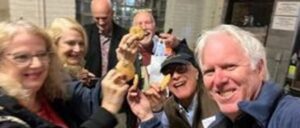
And that picture became iconic.
There we were, a bunch of sixty-eight-year-old teenagers, grinning over a pile of cookies like we had just raided the concession stand after a Friday night game. The photograph captured something that could not have been staged. It was ridiculous, affectionate, spontaneous, and perfect. It said more about friendship, memory, and reunion than any posed shot in front of a banner ever could.
It also launched a business.
At least in my mind.
Looking at that photograph, I saw what any sensible entrepreneur would see: a brand waiting to happen. Not just a cookie brand. A reunion brand. A nostalgia brand. A company built not merely on flour, sugar, butter, and chocolate chips, but on memory itself.
Becky’s Worldwide Cookies.
A favorite at every reunion.
The name had global reach. The backstory had emotional resonance. The founding photograph had authenticity. The target market was clear: aging high school classmates, sentimental boomers, reunion committees, former athletes, old flames, retired cheerleaders, long-lost lab partners, and anyone who ever walked into a party hoping somebody would remember them.
The business plan practically wrote itself.
Product launch: 2027.
For 2027, the first fifty cookies of every order would be complimentary, in honor of the 50th reunion that started it all. After that, of course, standard pricing would apply, because sentiment is wonderful but butter is expensive.
Naturally, the people in the photograph immediately became stakeholders. Andrea, Ginny, Steve, Anthony, and Dan all seemed to believe that their presence at the original cookie-consumption event entitled them to equity, royalties, residuals, image rights, licensing fees, and more.
I have taken the position that there would be no company without the consumption of the product in that picture.
Becky, of course, is the heart of the enterprise. Without Becky, there is no company, no mythology, no product, no origin story. She is the founder, the baker, the muse, and the brand. I am merely the visionary, which is to say the guy who had nothing to do with baking the cookies but immediately saw how the whole thing could be turned into a worldwide commercial phenomenon.
That is America.
But beneath the comedy of it all, there is something more tender.
The cookies mattered because they were never just cookies.
They were a small act of care. That was true in high school, and it was true fifty years later at the Cadieux Cafe. Becky did not bring them because she had to. She brought them because that was something she had once done, and because some part of her remembered that it had mattered. Maybe she did not even know how much.
That is the hidden architecture of a life. We remember the big events, of course—the graduations, the weddings, the deaths, the triumphs, the lawsuits, the betrayals, and the losses. But woven through all of that are the smaller gestures: somebody saving you a seat, somebody remembering your name, somebody sending a note, somebody showing up with cookies.
Those gestures can carry a surprising amount of weight.
At a 50th reunion, you become aware of time in a way that is almost physical. You look around the room and realize that everyone there has been carrying his or her own private history for half a century. Some people carried success lightly. Some carried grief invisibly. Some carried secrets. Some carried old wounds. Some carried joy. Some carried loneliness. Some carried stories no one had ever asked them to tell.
And then, in the middle of all that, there are cookies.
Maybe that is why the moment felt so good. It was simple. It was innocent. It was not about who had done well or who had not. It was not about status or accomplishment or regret. It was a group of classmates laughing over cookies at a Detroit cafe fifty years after high school.
There was a grace in that.
The next night, at the Detroit Yacht Club, the official reunion unfolded with all the polish and pageantry one would expect. People dressed up. Pictures were taken. Stories were exchanged. Names were remembered, forgotten, and remembered again. The room buzzed with the peculiar electricity of people who once shared hallways and homerooms and now compared grandchildren, new knees, old photographs, and memories that somehow remained seventeen years old.
But for me, the Cadieux Cafe cookie moment had already become the heart of the weekend.
It was not polished. It was not planned. It was not dignified. It was better than that.
It was alive.
In the years since, I have thought about that photograph and what it represents. Six classmates caught in a tiny conspiracy of delight. Becky’s cookies at the center of it. A private gift becoming communal property. The past reaching gleefully forward.
That is why Becky’s Worldwide Cookies deserves to exist, even if only as a running joke, a mock business plan, a fantasy product launch, and a sweet little monument to friendship. Some companies are founded on technology. Some on proprietary processes. This one was founded on butter, sugar, chocolate chips, reunion laughter, and the memory of a girl who brought cookies to the basketball bus.
If the company ever does launch, we will need a slogan.
“Becky’s Worldwide Cookies: Because Somebody Had to Feed the Class of ’72.”
Or perhaps:
“Becky’s Worldwide Cookies: Fifty Years Later, Still Worth Fighting Over.”
Or maybe the simplest one is best:
“Becky’s Worldwide Cookies: A Favorite at Every Reunion.”
That one has staying power.
And if we ever do take orders, people can email Becky and Tom at beyondgrossepointe@gmail.com to learn more. Operators will not be standing by, because we have not yet hired operators. The board remains unsettled. The equity stakes still being negotiated. The cookie monsters are making unreasonable demands. Legal counsel has advised me not to comment further.
But I will say this.
In 1972, Becky Beyer brought cookies to the basketball bus.
In 2022, she brought them again.
And for a moment at the Cadieux Cafe, fifty years disappeared.