I was brought home from Cottage Hospital in Grosse Pointe Farms on a crisp fall day in October 1954 to begin my life on a street called Grand Marais in Grosse Pointe Park, Michigan.
Looking back now, I realize that who I became is, in many ways, a composite of all the people who populated those early years. The families, the children, the parents, the grandparents, and even the pets all left their mark on me—Pierre, Heidi, Lance, Cobber, Sam & Duke. There were easily a hundred people who inhabited my little world during those formative years, and pieces of all of them remain with me today.
At seventy-one years old, I find myself missing them all.
I miss the people. I miss the houses. I miss the sounds. I miss the lake. I miss the rhythms of daily life on that little two-block stretch between Jefferson Avenue and Lake St. Clair.
And yet, when I think about Grand Marais, the dominant emotion is not loss but gratitude. The neighborhood as it existed then may be gone, but what it gave me remains. The feeling survives, deeply rooted in my soul and psyche, continuing to shape me all these years later.
It is a shame that so little connection remains to that wonderful world that provided such fertile ground for who I and others were to become, who we would love, what interests we would pursue, what careers we would choose, and how we would ultimately view the world. Grand Marais was more than a street. It was an ecosystem of affection, laughter, love, and belonging.
No single family raised me.
In a sense, the entire street did.
And not just Grand Marais.
Although Grand Marais was the center of my universe, childhood in those days did not stop neatly at the corner. One street over to the east was Whittier. To the west was Three Mile Road. We had many friends on both. The boundaries between those streets seemed almost imaginary to us. Children flowed back and forth from one block to another with the ease of birds crossing lawns.
Grand Marais kids had Whittier friends.
Grand Marais kids had Three Mile Road friends.
Those neighboring streets expanded our world without diminishing the closeness of our own. Together they formed a larger childhood kingdom, one that stretched beyond the houses we lived in and into the lives of children whose homes, porches, backyards, and parents became part of the same remembered landscape.
Grand Marais possessed qualities that made it unique. One end of the street connected us to Jefferson Avenue and the wider world. The other terminated at Lake St. Clair. Between those points, towering elm trees arched overhead, forming a long canopy tunnel. Grand Marais ended not with a dead end but with a small circular island, a kind of neighborhood roundabout before most of us had ever heard the term. Cars could drive to the end of the street and then drift slowly around it before heading back the other way.
At the foot of Grand Marais, beyond the turnaround, was a broad green commons with a long seawall wide enough to sit on while overlooking the lake. It wasn’t a park exactly, but it functioned as one. Children played there, neighbors gathered there, and it provided a wide, unobstructed view of Lake St. Clair. To us, Lake St. Clair was one of the Great Lakes whether the geographers agreed or not. Adjacent to that was a large open field where many a pickup baseball or football game took place.
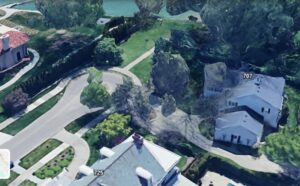
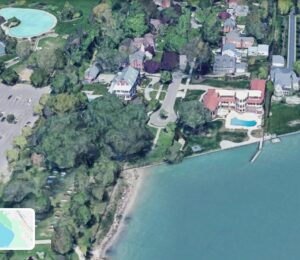
The seawall became one of our main gathering places.
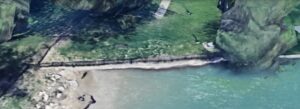
We sat on it for hours. We fished from it. Before the thousand-footers began plying the lake, we watched 600- to 800-foot freighters crawl across the horizon carrying iron ore, coal, limestone, and other cargo. Canada formed the backdrop while their whistles echoed across the water, each blast carrying with it a sense of mystery and adventure.
We shared stories, secrets, dreams, and occasionally our troubles. The lake was more than scenery. It was part of the neighborhood’s identity.
I lived at the end of the street—last house on the right so I was close enough to drag a canoe off our property onto the green commons up over a mound at the right end of the seawall and down the bank into the water. I had done it so many times there was a groove in the earth that facilitated a fairly easy launch. During summer my friends and I would hit the lake with our fishing gear at six thirty in the morning and not return until mid-afternoon. The day would just fly by.
We also had a small fleet of 6 foot dinghies that my older brother would take out in summer evenings with friends at the lake not going too far from the house but far enough to feel unsupervised and unrestained. Judging by the variety of gleeful sounds of teenage freedom coming from their direction they were in their heyday.
The cul-de-sac created a sense of safety and enclosure while the lake provided openness and possibility. Together they created a rare combination. Few streets in Grosse Pointe possessed such a gift.
We even had our own place of worship in the neighborhood. Mrs. Distel, a very devout and religious woman, lived in a large, cavernous home on the lake directly across the street from my family home. Inside that home was a real chapel complete with towering ceilings, kneeling pews, stained-glass windows, and a genuine pipe organ. It was extraordinary. It was as though a small church had been tucked away inside a private home. She loved to have us come over and pray with her.
That home many years later would be owned and occupied by Bob Seger and the Silver Bullet Band’s super sax man, Alto Reed, his wife Monica, and their two daughters.
Beyond our immediate neighborhood lay one of the great landscapes of my childhood. Mrs. McMillan’s estate occupied a vast stretch of property extending from Essex Avenue all the way to Lake St. Clair. Adjacent to her property was another large tract of open land that had once belonged to the military and would eventually become one of the crown jewels of the Grosse Pointe system of parks.
Together, the two properties created an area of open space that was enormous. Long before portions of the area became a park, it stood as a place of mystery and possibility, inviting exploration and adventure. We weren’t concerned with property lines, ownership, or history. We simply knew it was there—a vast green landscape bordering our little world on Grand Marais.
Between the lake, the seawall, the grassy commons at the foot of our street, Mrs. McMillan’s estate, and the great open tract beyond, Grand Marais offered children something that seems increasingly rare today: room.
Room to roam.
Room to imagine.
Room to dream.
Room to grow.
Looking back, I realize those spaces were every bit as important as the people. They formed the stage upon which the stories of our childhood unfolded and helped make Grand Marais feel less like a street and more like a world unto itself.
And in winter, that world changed completely.
The vast open space bordering Essex became something magical when the cold settled in. There were two skating rinks, side by side in spirit if not always in perfect geometry. One was designated for hockey, where the more aggressive skaters chased pucks, swung sticks, and slammed into snowbanks with competitive purpose. The other was for free skating, where the rest of us circled and glided and wobbled and dreamed.
Those rinks were formative.
They belonged not just to Grand Marais, but to Whittier, Three Mile, and the wider neighborhood of children who converged there when the ice was good. In summer, we had the lake and lawns and seawall. In winter, we had the rinks.
One old friend from Whittier remembered it perfectly: “Please do remember the ice rinks in winter. Everybody swirling around. I especially remember skating at night. I don’t know how many girls I fell in love with that way.”
I know exactly what he meant.
There was something about skating at night that enlarged childhood. The cold air sharpened everything. The scrape of blades on ice. The muffled sound of voices. The occasional shout from the hockey rink. The glow of nearby lights on the frozen surface. Kids moved in circles, pairs, clusters, and sudden bursts of speed. Some were graceful. Some were hopeless. Most of us were somewhere in between.
There were benches where we sat to lace up our skates, and getting those skates tight enough was a serious matter. Loose skates could ruin the whole experience. Ankles buckled. Blades wobbled. Pride suffered. Many times we helped one another pull the laces tighter, working the leather into submission. Sometimes it was boy helping boy or girl helping girl. But sometimes it was girl helping boy, or boy helping girl, and that alone could make a winter evening memorable.
Then there was Crack the Whip.
Crack the Whip was one of those childhood games that somehow managed to be innocent, dangerous, thrilling, and socially useful all at once. There would be a lead skater, and everyone behind him or her would hold hands, forming a long human chain. The lead skater would begin moving in one direction, gathering speed, then suddenly turn or stop. The force would travel down the line until the last skaters were whipped around with alarming velocity.
The idea, of course, was to see whether the chain could hold.
Often it could not.
Kids would go flying off in every direction, collapsing onto the ice in laughter, embarrassment, or both. It was centrifugal force disguised as recreation.
It was also one of the few games that practically required holding hands with members of the opposite sex. In that sense, Crack the Whip was more than a skating game. It was a small rite of passage. A sanctioned excuse for contact. A way for shy boys and girls to hold hands without admitting that holding hands had anything to do with it.
We probably did not understand that at the time.
Or maybe we understood it perfectly.
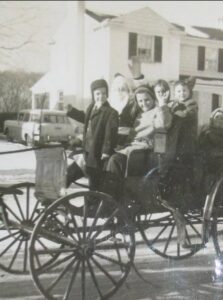
Along with the great skating winter was occasionally graced by Santa’s open, horse-drawn wagon ride through the neighborhood. One family kept the wagon on their front lawn year-round, and each holiday season it was put back into service, transformed once again into Santa’s carriage.
One of the great recurring experiences of our childhood took place every Halloween. Mrs. McMillan’s home sat at the end of a long driveway that seemed to stretch forever. For most of the year, it remained a place glimpsed through a gate at a distance, partially hidden beyond expansive lawns and mature trees. But on Halloween night, it beckoned.
Costumed children would make the long pilgrimage down that driveway toward the circular drive in front of Mrs. McMillan’s home. The journey itself felt magical. Looking back, it reminds me of Dorothy and her companions following the Yellow Brick Road toward the Emerald City. We marched along in our homemade costumes carrying pillowcases and shopping bags, filled with anticipation about what awaited us at the end. At that time in history, there were no fears of razor blades in Halloween candy.
The home was grand and mysterious, almost castle-like in my memory. As we approached the front door, the excitement would build. It wasn’t simply another stop for candy. It was an event. A destination.
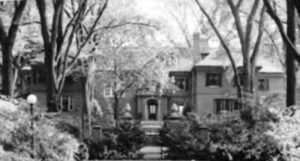
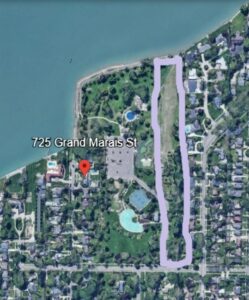
The area of the former McMillan Estate property. In this google earth aerial shot it is part of Patterson Park. The mansion was about half way to the lake.
Looking back now, I realize how extraordinary it was.
The families who lived on Grand Marais seemed to come straight from the television shows of the 1950s and early 1960s.
There were Ozzie and Harriet families.
There were Leave It to Beaver families.
There were Dennis the Menace families.
There were Father Knows Best families.
There were Donna Reed families.
There were My Three Sons families, which included mine—my dad and his three sons: me, my brother Michael, and my brother David.
Of course, none of them fit neatly into a television script. Real life was messier, funnier, sadder, and far more interesting than anything Hollywood produced. Yet those television families provide the closest shorthand I know for describing the wonderful cast of characters that populated my childhood.
Every house contained a story.
Every family contributed something to the larger tapestry.
There were dogs that seemed to belong to the entire neighborhood.
There were baseball games, football games, outdoor and indoor forts, scraped knees, practical jokes, arguments, friendships, and first crushes.
Looking back now, I am amazed by the lives that emerged from that two-block stretch and the adjacent open space.
Among the children who grew up on Grand Marais were future commercial pilots, veterinarians, engineers, doctors, builders, entrepreneurs, psychologists, inventors, priests, and many others whose futures were still invisible to us then.
At the time, none of us could have predicted where life would take us.
The future pilot was just another kid riding his bike.
The future psychologist was a kid who made a daily walk down to the seawall.
The future veterinarian was a kid who loved animals, had two dogs, and had a large afternoon paper route.
The future entrepreneur was another youngster teaching tennis and mowing lawns.
The future inventor was a kid building elaborate miniature plastic models of exquisite cars in his father’s study.
The future engineer was a youngster building soapbox derby cars and go-karts in his garage as well as being the best fisherman on the block. I was a close second.
Grand Marais was an incubator of possibility.
The adults who raised us could not have known what would become of the children running through their yards and across their sidewalks. Yet somehow they created an environment in which all those futures could take root.
As the years passed, life unfolded for all of us.
Children grew up.
Parents aged.
Families moved away.
Some stories ended happily.
Others did not.
There were health issues.
There were betrayals.
There were sibling rivalries that fractured relationships.
There were marriages that flourished and marriages that failed.
Some found the courage to come out of the closet and live more authentic lives.
The realities of adulthood eventually touched nearly every family.
Yet none of those later events have sullied the way I carry Grand Marais in my heart.
When I think of Grand Marais, I do not first see the tragedies and disappointments that came later. I see the ordinary moments.
I see bicycles lying in driveways and front yards.
I see children sitting cross-legged on the Fannons’ front lawn at the corner of Grand Marais and Essex, chatting about nothing in particular, absentmindedly chewing on blades of grass as the afternoon drifted by.
I see baseball gloves and bats tossed on porches and roller skates abandoned on sidewalks.
I hear screen doors slamming, dogs barking, fathers admonishing their kids for some minor mischief, and mothers calling children home for dinner.
I see children playing in sprinklers on the Tyrees’ front lawn.
I hear laughter and excitement.
I smell freshly cut grass on a summer evening and feel the cool breeze coming off Lake St. Clair.
The children of Grand Marais did not require organized activities, scheduled play dates, or adult supervision to keep us occupied. We had a street, a lake, vast open space, a collection of friends, and endless imaginations. We were truly blessed.
We played games that today’s children might scarcely recognize.
One favorite was SPUD. A ball would be thrown into the air and children would scatter in every direction. When the ball was caught, the holder would yell “Freeze!” and everyone stopped where they stood. The player holding the ball would size up a target and launch a throw while the rest of us braced for impact. The anticipation was often more exciting than the throw itself.
We played Statues on the Deebs’ front lawn, freezing in ridiculous poses and struggling not to laugh or move. We played Mother, May I? on the sidewalk in front of the Lloyds’, taking giant steps, baby steps, and bunny hops toward an ever-changing finish line. Looking back, it amazes me how much enjoyment we extracted from games requiring little more than a patch of pavement and a handful of children.
Like most neighborhood kids, we also invented games. At the Chanceys’, one of our favorites involved throwing a ball onto the pitched roof of their garage and waiting for it to return. Nobody knew exactly where the ball would emerge. The moment it rolled off the roof, a scrum would erupt as half a dozen kids lunged and jumped to make the catch. I can’t remember if there was any scoring involved.
The street itself was our playground. Front lawns became playing fields for football—like in front of the Boyds’ house. Backyards became places for wiffle ball home run derby—swinging for the fences like behind the Byrons’ house. Driveways became basketball courts, like behind my house. The Fannons had a pool in their backyard with towering pine trees, a shuffleboard court, and a Florida room overlooking the backyard. The seawall at the lake became a place to fish, talk, daydream, and watch the world drift by. We moved freely from yard to yard and house to house, creating adventures from whatever happened to be available at the moment.
Of course, Grand Marais was not all innocence, elm trees, lake breezes, and noble childhood adventure. We had our share of mischief on the block.
One episode involved two older boys—two years older than I was, and who shall remain mercifully anonymous—who dared me to toss a couple of homemade paint grenades against a neighbor’s garage door. Why we chose that particular house, I honestly cannot remember. Maybe there was no reason at all, which is often how childhood mischief works. We filled two balloons with white paint, tied them off, and I launched them over the back fence.
Target reached.
There was a tremendous splat against the garage doors and down onto the driveway. White paint everywhere. Naturally, there was an investigation. Just as naturally, I eventually came forward. My punishment was swift and old-school: I had a date with a razor strap. In truth, I got off easy. My mother was the executioner, and I believe the sentence was five lashes. Five lackluster lashes but the symbolism was there.
Then there was the winter evening, just at dusk, when a few of us decided to pelt a neighbor’s windows with snowballs. He was a humorless executive type, or at least that is how we saw him, and for whatever childish reason we held him in contempt. Out he came, charging from the house in his starched white shirt and tie, determined to catch the culprits.
He did not catch us.
Instead, in hot pursuit, he slipped in the mud near the storm drain and went down. He wasn’t hurt, thankfully, but he was a mess—white shirt, tie, executive dignity, and all. We scattered into the winter darkness and escaped accountability.
Looking back, I cannot defend any of it. But I can still see the street, the snow, the muddy drain, the splattered paint, and the terrible seriousness with which adults tried to bring order to a world that, to us, existed mostly as one long opportunity for play, daring, escape, and the occasional very poor decision.
At the time, we thought all neighborhoods were like ours. Only later did we realize how fortunate we were. We possessed an entire community that trusted one another enough to let children roam, explore, invent, and play. Looking back now, those games seem less important than what they represented. They were the language of a neighborhood where children belonged not just to a family, but to a street.
Those moments seemed ordinary at the time. Looking back, I realize they were extraordinary. They were the building blocks of a childhood that felt safe, connected, and deeply rooted in community.
The sum of the love and light back then dwarfs whatever darkness may have followed in life.
I know this because, many years later, when darkness did come, Grand Marais was still there for me.
In 2009, when I was disintegrating financially because of a shameless, unapologetic polluter who had contaminated a property I owned and refused to take financial responsibility for the damage done, I found myself returning again and again to the safest place on earth.
The foot of Grand Marais.
The seawall.
The lake.
The two giant cottonwood trees that had stood there since my youth.
I would go there and lie down beneath those trees, looking up at the bright cumulus clouds moving across the blue, blue sky. At a time when my life felt as if it were coming apart, that spot offered me something I could not find anywhere else: peace, tranquility, and the faint but necessary return of hope.
It was more than a place.
It was a sanctuary.
It was a portal.
I could step into it and, for a little while, feel restored. The lake, the sky, the trees, and the memory of that childhood world seemed to recharge my soul and spirit. In the midst of financial collapse, betrayal, anger, and fear, Grand Marais gave me back some piece of myself.
That is how deeply the street lives in me.
It was not merely where I grew up.
It was where I could return, even decades later, when I needed to remember who I was before the world had wounded me.
Years later, I returned to visit Grand Marais again.
I parked at the corner of Essex and Grand Marais and began walking toward the lake.
Almost immediately something extraordinary happened.
There, pushing a lawn mower much as he had decades earlier, was Clem.
As children, we knew him as the kind, humble man who cut a number of the lawns on our block. For him, it was a second job. He had several mouths to feed.
Time had marched on. Families had come and gone. Parents and grandparents had passed away.
Yet somehow there was Clem.
As I watched, the front door of one of the homes opened and Mrs. Byron stepped outside to retrieve her newspaper.
“Good morning, Clem,” she called out.
“Good morning, Miss Norma,” he replied.
That was it.
Just a simple exchange.
But in that instant, I was transported backward through time.
How many hundreds of times had those exact words passed between them over the years?
The timing of my presence on the sidewalk in front of the Byrons’ house at that exact moment was so improbable that it felt scripted.
For a few seconds, the decades disappeared.
I was no longer a man revisiting his childhood neighborhood. I was a boy again.
It was one of the strangest experiences of my life.
Not nostalgia.
Not memory.
Something closer to time travel.
Had a filmmaker included the scene in a movie, I would have dismissed it as too contrived. Yet there it was, unfolding before me on an ordinary morning on a street that somehow still remembered itself.
And for a brief moment, so did I.
It was a Back to the Future moment.
Sometimes I fantasize about a Grand Marais reunion.
Not a small reunion.
A grand reunion.
More than fifty years have passed.
Some of us would recognize one another instantly. Others would require name tags and a few minutes of conversation before the faces of our youth emerged from behind the wrinkles and gray hair.
Many of the parents and grandparents would be absent, present only through stories and memories.
Yet I imagine us gathered together once again.
Laughing.
Reminiscing.
Remembering.
Telling stories about those who were not present.
Marveling at how quickly an entire lifetime can pass.
Perhaps we would discover that Grand Marais still inhabits all of us.
Perhaps each of us carries our own version of that little street inside us.
I know that I do.
Even now, after all these years, I can close my eyes and see the lake.
I can see the seawall.
I can see the bicycles.
I can see the families.
I can see the boys and girls from Whittier and Three Mile joining us as though they had always belonged.
I can see the winter rinks along Essex.
I can hear blades scraping across the ice.
I can feel a mittened hand in mine during Crack the Whip.
I can see those two giant cottonwoods.
I can see myself lying beneath them in 2009, staring up at the clouds, trying to hold on.
I can hear the voices.
I can hear the laughter.
And I can feel the love.
Grand Marais no longer exists as it once did.
But it continues to exist within me.
The street that inhabits me still.