Vigilante’s ambush collars S.F. suspect / North Beach tax accountant turns to stun gun after police shelve his requests for arrest in theft
By David Parrish,Chronicle Staff WriterJune 24, 2002
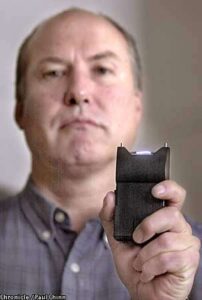
Tom Van Lokeren armed himself with a stun gun (shown), pepper spray and a fishing net to apprehend a man who had stolen his checks, credit cards and his identity. PAUL CHINN/S.F. CHRONICLE
I did not wake up on June 24, 2002 intending to share newspaper real estate with Osama bin Laden.
I am an accountant. I deal in spreadsheets, documentation, and the quiet belief that if you follow the rules long enough, someone eventually shows up to enforce them. But on that morning, when I unfolded the San Francisco Chronicle, there I was—above the fold—my face sharing space with the most wanted man on earth.
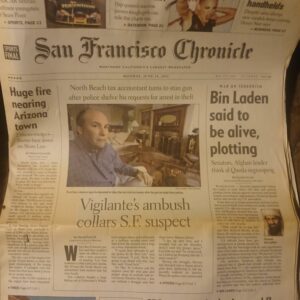
This was not a career milestone I had planned.
My venture into vigilantism did not begin with rage or ideology. The rage came later. It began with a phone call from my credit card company asking if I had recently purchased DJ equipment in Berkeley. I had not. When I checked my home office, two credit cards were gone. And several client checks made out to me. Then the realization that my identity was now enjoying a social life I had never authorized.
I did what responsible citizens are encouraged to do. I went to the police.
At the San Francisco Police Department’s Central Station in North Beach, I arrived with evidence already organized—names, dates, receipts, suspect’s identification and stolen identifications of dozens of his other victims found in a secret compartment in a duffel bag he had left behind. I had narrowed it down to one man — James Timothy Stevens, a co-worker of my nephew who had recently stayed in my North Beach flat as my nephew’s guest and according to the officer taking my report was already a convicted criminal and wanted on multiple warrants for First Degree Burglary, Grand Theft, Receipt of Stolen Property and other offenses. I had not brought a mystery. I had brought a solution.
The police just wrote a report at which point my nephew, exasperated, called them “secretaries with guns.”
When the suspect called my nephew asking to retrieve a duffel bag he had left behind — not knowing that his criminal activity had been discovered — we conspired to arrange a meeting with him at the Metreon theatre on 4th and Mission to return his duffel bag. I returned to the police station to inform them that the man they were too busy to arrest was about to present himself voluntarily at a fixed location and time to retrieve his duffel bag.
When asked if they could arrest him, they explained that resources were limited. Violent crime took priority. Identity theft, it turned out, was an inconvenience, not an emergency. I returned. I followed up. I escalated. At last count four times. Eventually, one officer suggested I call 911 if the suspect appeared. Another wished me “good luck.”
That was the moment I understood something important: the system was finished with me. Even though I was offering them up a convicted criminal on a silver platter — an easy W for the win column.
So I went shopping.
I purchased a large fishing net at Fisherman’s Wharf. I bought two pepper spray devices at a local Army Surplus store on Market. I added a stun gun for extra measure. I kept the receipts. Old habits die hard.
Charles Bronson made a career out of vigilantism. He did it on elaborate Hollywood sets with a full crew of professionals. I did it with a nephew, a cell phone, various implements of aggression and a plan that should have relied heavily on cooperation from professionals who had already declined to help.
On Mission Street, the execution of our plan lasted less than a few minutes. Hiding across the street in a storefront I crossed the street and ran up behind him on the sidewalk and delivered a shock from the stun gun to his neck. Then pepper spray to his face as he turned his head. Then my nephew hit him with pepper spray from the front. Stevens collapsed on the sidewalk. Regrettably the fishing net never made it to the scene or he would have been immediately subdued and ensnared in the net. It had been inside my shirt but fell out during the chaos. He was not down for long before he scrambled to his feet and ran across Mission Street. We gave chase yelling “thief, thief!” Strangers joined in. An amputee in a wheelchair, with his full leg, nearly tripped him up. And about 50 yards down the sidewalk a kindred vigilante — body-checked him into a liquor store door, which shattered dramatically, as if the universe wanted to make sure this stayed interesting. I have imagined the alternate version of the scene — the quiet one — where we’re standing over him ensnared in a fishing net, the chaos already over. But in that version, there’s no chase. And without the chase, the story loses some of its punch.
I can only imagine the 911 switchboard lighting up like a Christmas tree as four squad cars with six officers arrived on the scene in short order when only a couple of officers could have gotten the job done in front of the Metreon at 4th and Mission. James Timothy Stevens was placed under citizen’s arrest. As he sat on the sidewalk leaned up against the liquor store door, red eyed with pepper spray, he was observed trying to slide the stolen credit cards where they could be overlooked. Suddenly, the system re-engaged — BUSTED!
On the scene police officers lectured that what we had done was dangerous — taking the law into our own hands. They discouraged vigilantism. They warned of potential violence. My nephew and I were separated and each interviewed to give our accounts. I listened politely. It is much easier to warn someone after the outcome is known. In part the purpose of that interview was to determine if I we had used excessive force.
There had recently been a multi-part series running in the San Francisco Chronicle quite critical of the SFPD. Marcie Powers, my fiance, a public relations executive with a high tech company in San Francisco at the time, seized on that intelligence and pitched the story to the reporter with the Chronicle running that series. He bit and the next morning we were in the William Randolph Hearst SF Chronicle building on Mission Street being interviewed by Chronicle writer David Parrish. Even after an interview with a reporter you never know whether a story will go to print. About two weeks later at 6 am I got a call from another nephew, Matt, informing me that I was on the front page of the San Francisco Chronicle. I grabbed the paper from the front porch and there I was. Above the fold. The vigilante accountant. To the right: Bin Laden said to be alive, plotting, Senator — Afghan leader think al Qaeda regrouping. Somewhere between us lay the editorial decision that this was all part of the same world.
What followed was not accountability.
It was publicity.
For two weeks, it was a national story. Not because the system had failed, but because the failure had good optics. I did interviews on sixteen radio stations across the country. I appeared on national television to discuss the merits of vigilantism—an odd exercise, considering no one had wanted to discuss that subject when I was standing at the police counter with evidence in my hands.
I engaged in a vigorous debate on television with a New York cop on MSNBC’s The Abrams Report about the wisdom — and the risks of vigilantism and citizen’s arrests. He was firmly against it. I was firmly in favor and of not being ignored by law enforcement.
The story even reached Rush Limbaugh’s nationwide morning program, where it was heard by millions of his “Dittoheads.” On air, he offered kudos to me and my nephew for making a citizen’s arrest, especially in that it was a response to the abdication by the police of their responsibility — framing the episode through a distinctly pro-vigilante lens. My brother David’s longtime friend, John Fannon, a regular Limbaugh listener, was driving on Harsen’s Island and almost drove off the road hearing our family name. I wish I could have been there to see that!
Morning television followed. Makeup. Coffee. Laughter. I found myself sitting on couches discussing citizen’s arrests and demonstrating the operation of a stun gun—as if this were a career pivot rather than an accident of circumstance.
I remember KTVU Mornings on 2 host Ross McGowan nearly jumping out of his chair when I sent a stun gun’s electric charge snapping into the air—not in his direction, of course, but close enough to make the point.
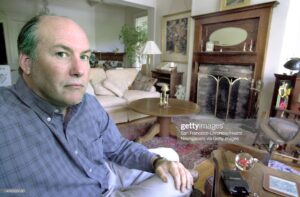
News vans would pull up outside Marcie’s and my apartment in a Victorian era building on Broadway. Cables snaked across the sidewalk. Neighbors pretended not to stare. I was briefly famous for doing something I never wanted to do in the first place.
It was fun.
It was exhilarating.
It burned pure adrenaline.
And it was completely untethered from the problem that started it.
No one called to say, We’re sorry we didn’t help you.
No one asked how many hours I had spent trying to get things done the right way sans vigilantism.
The story had moved on from theft and institutional indifference to something far more marketable: spectacle.
For two weeks, I was not an accountant. I was a real life Charles Bronson with a stun gun, pepper spray and a fishing net. I almost made it onto the pages of People magazine but for the lack of timely pitching of the story.
Then, just as suddenly, it ended.
Charles Bronson went on to his next movie. I went back to work after the story ran its course. I returned to tax returns, spreadsheets and audits.
Above the Fold, I learned that year, is a fast acting drug with a short half life.
And sometimes, when institutions don’t show up and chaos fills the gap, an accountant finds himself — deciding to not just be another victim statistic but to take matters into his own hands.
What I did not expect was the after effect.
Once you have stood in public and refused to sit down again, something changes. Once you have spoken into a microphone, argued your case on live television, and survived the consequences, the fear that keeps most people quiet loses its grip.
After that, standing up in public no longer felt extraordinary. It felt available.
I protested social injustices. I challenged local corruption. I brought uncomfortable facts to the attention of people who preferred not to receive them. I learned that outrage, when documented and calmly delivered, has weight. I learned that silence is often the most efficient accomplice power has.
Most importantly, I learned not to accept what is unacceptable simply because it arrives with authority.
Years later, when every polite channel failed again—when the contamination of one of a property of mine was ignored, minimized, delayed, and buried—I did not hesitate the way I once might have. I already knew how this worked. I already knew that institutions do not correct themselves out of goodwill.
So I put on a hazmat suit and exercised my prerogative once again. That was in 2010.
Not as theater but once again as a last resort.
That moment traced directly back to this one. To the day I discovered that compliance does not guarantee justice, and that sometimes the only way to make a system respond is to become visible enough that it can no longer look away.
I did not become reckless.
I became unwilling.
Unwilling to accept the unacceptable.
Unwilling to normalize the outrageous.
Unwilling to confuse patience with virtue.
The vigilante accountant was never the point.
The point was learning that once you step forward, you don’t fully step back again.
Above the fold was temporary.
The change it set in motion was not.
Epilogue:
James Timothy Stevens was arraigned and booked for two felonies committed against me in San Francisco. He was then extradited to San Diego where he was incarcerated for several prior felonies committed in Southern California.
At his hearing the parents of a girl he held against her will in the Lake Tahoe area were in attendance. They rescued their daughter but no charges were ever filed. She spent 6 months at a special psyche facility in Colorado to heal the trauma.
live link to original San Francisco Chronicle article (tap to open):
https://www.sfgate.com/news/article/vigilante-s-ambush-collars-s-f-suspect-north-2826829.php